
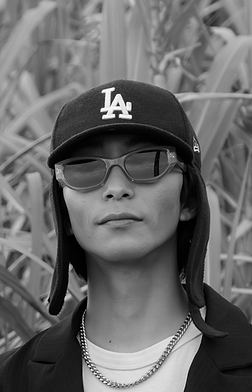
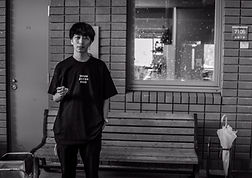
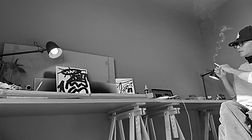
バイオグラフィー
1998年兵庫県生まれ。
無幻は幼少期から「自由」を強く志向し、学校や社会の規律に対して違和感を抱いていた。
整列や画一的な行動様式といった統制の仕組みに対し、目的地に到達することが本質であるならば、
なぜ過程まで管理されなければならないのかという疑問を持っていた。
生徒たちが同じ髪型や服装を求められ、個性が削ぎ落とされていく環境を、社会のベルトコンベアーに乗せられるような感覚として捉えていたという。
また幼少期から両親に「どれだけ親しくなっても宗教の話はするな」と言い聞かされて育ったことも、
彼の内面に消えない問いを残した。
信仰がタブーとして扱われる日本社会の構造は、後の制作テーマへと接続していく。
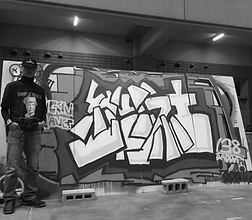
大学時代、ヒップホップ文化と出会い、その反骨精神に強く共鳴する。
ダンス部の先輩を通じてグラフィティに触れ、エアロゾルスプレーによる制作を経験したことが、
現在の表現の原点となった。
幼少期から絵を描くことを好んでいたが、芸術そのものに強い関心を持ったのは社会人になってからである。それまで彼は芸術を「意味の分からない無意味なもの」と捉え、過剰に神聖視されている存在として距離を置いていた。
しかし 村上隆 の著書『芸術起業論』との出会いが、その認識を大きく転換させた。
この一冊は、「芸術は感性のまま自由に描くもの」という自由神話と、「社会的に無意味である」という固定観念を打ち破った。
さらに、前澤友作 が Jean-Michel Basquiat の作品を高額落札したニュースを契機に、バスキアの表現に強い衝撃を受ける。生命力に満ちた筆致と反骨精神、そして人種差別や社会問題に切り込む姿勢は、無幻の制作思想に決定的な影響を与えた。
彼は芸術には社会を批評し、普段は見過ごされている視点を可視化し、社会の構造に揺さぶりをかける
役割があると考えている。
作品を通して、日本社会においてブラックボックス化された信仰心や、資本主義の影に隠された問題、
そして現代人から忘却されつつある記憶を再び浮上させることを試みている。
彼にとって制作とは、
社会に対する異議申し立てであり、
沈黙を強いられた精神の暴露であり、
均質化された日本の構造への反抗である。
ブラックボックス化された信仰、消費に回収される個性、資本主義の影に隠れた精神の空洞。
彼はそれらを再び可視化する。
作品は問いではない。
告発である。
制作は表現ではない。
抵抗である。
無幻は、日本の精神構造を暴き出す。
Born in 1998 in Hyogo, Japan, Mugen developed a strong orientation toward “freedom” from an early age and felt a deep discomfort toward the rules and discipline imposed by schools and society. Confronted with systems of control such as enforced lines and uniform modes of behavior, he questioned why, if reaching the destination was the essential goal, even the process had to be strictly regulated. He perceived the environment—where students were required to adopt the same hairstyles and clothing, their individuality gradually stripped away—as akin to being placed on a social conveyor belt, mass-produced into uniform products.
From childhood, he was also repeatedly told by his parents, “No matter how close you become to someone, never speak about religion.” Growing up under this injunction left an enduring question within him. The structure of Japanese society, in which faith is treated as a taboo, would later become a central theme in his artistic practice.
During his university years, he encountered hip-hop culture and strongly resonated with its rebellious spirit. Through a senior member of his dance club, he was introduced to graffiti, and his early experiences painting with aerosol spray became the foundation of his current mode of expression.
Although he had enjoyed drawing since childhood, it was only after entering the workforce that he developed a serious interest in art itself. Until then, he regarded art as “something meaningless and incomprehensible,” distancing himself from what he saw as an excessively sanctified domain.
However, his perception changed dramatically upon encountering Takashi Murakami’s book Geijutsu Kigyōron (The Business of Art). This single volume shattered both the myth that “art is something created freely according to one’s sensibility” and the assumption that art is socially meaningless.
Further impact came when news broke that Yusaku Maezawa had purchased a work by Jean-Michel Basquiat for an extraordinary sum. Basquiat’s explosive vitality, defiant spirit, and incisive engagement with racism and social injustice profoundly shaped Mugen’s artistic philosophy.
He believes that art has the role of critiquing society, rendering visible perspectives that are usually overlooked, and unsettling existing social structures.
Through his work, he attempts to resurface faith rendered into a black box within Japanese society, the problems concealed in the shadow of capitalism, and memories that are gradually being erased from contemporary consciousness.
For him, artistic production is:
an objection raised against society,
an exposure of silenced spirituality,
a rebellion against the homogenized structures of Japan.
Black-boxed faith.
Individuality absorbed into consumption.
The spiritual void hidden in the shadow of capitalism.
He makes them visible again.
His works are not questions.
They are accusations.
Creation is not mere expression.
It is resistance.
Mugen exposes the spiritual structure of Japan.